Until the weekend, the fact the public have the right to walk nearly anywhere on Scottish land (responsibly and within reason) made the country seem like a hiking Nirvana. I’ve reassessed that view.
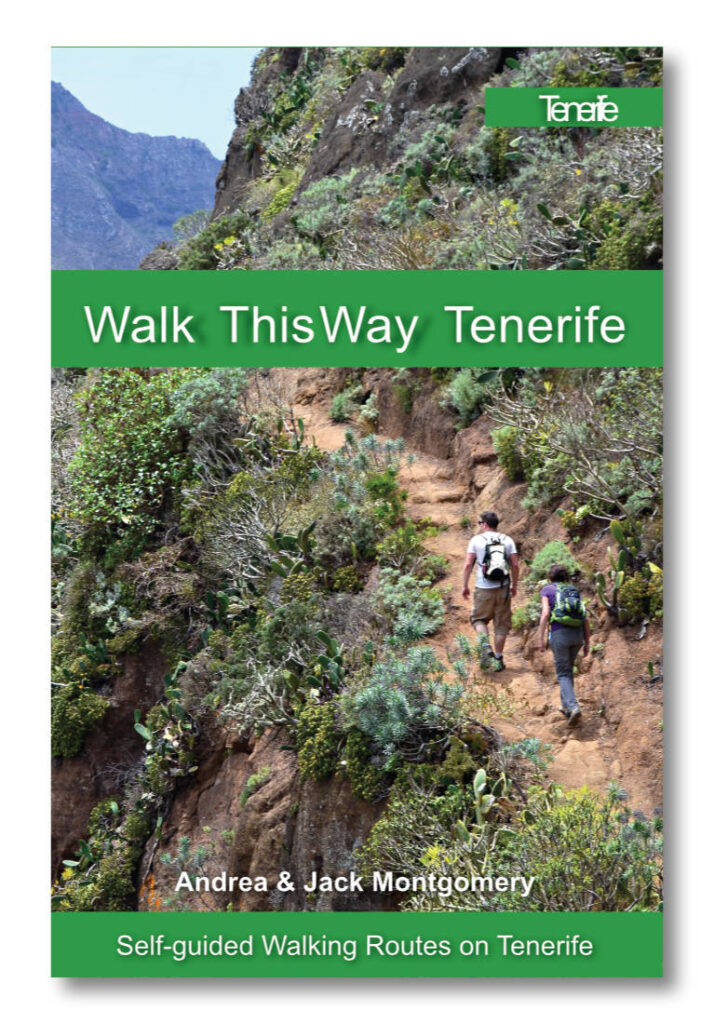
Over the last two decades, Andy and I have written directions for walking routes in numerous destinations around Europe. The first were on Tenerife, prompted by us not being happy with a hiking guidebook we bought locally. Since then, we’ve mapped out routes for all but one of the Canary Islands, various off-the-beaten-track locations in Spain, Italy, Portugal, Greece, Slovenia, Austria, Germany, France, Wales, and England. But not Scotland.

Walking a signed path in Dumfries & Galloway.
Because of our experience, we can be over-critical of hiking guides which contain vague directions with no distances between key points or no specific instructions when the way ahead is unclear. This happens most commonly in free walking guides, but we’ve also experienced it with companies where we’ve paid a lot of money for a walking holiday (e.g. Chile, Offa’s Dyke in Wales). This weekend we followed possibly the worst directions we’ve ever used.
How they were written was the prime reason they weren’t fit for purpose, but Scotland’s Right to Roam played a role in what turned out to be a hiking fiasco.
Poor hiking directions
In theory, a short, circular trail from Rothesay taking in the summit of Barone Hill was an easy one to follow. I could see directions were minimal, but it’s not a complicated route. Anyway, I walked up Barone as a boy. Plus, there was an OS type map illustrating the way.

Lovers’ Lane, Rothesay.
The route took us through the High Kirk, along Lovers’ Lane, and onto the road leading to Loch Fad. So far, no need for directions. As soon as they were required, I realised they were worse than I thought.
“…turn left, then right, through a gate.”
Clear enough, except there were two gates close to each other. The directions didn’t specify which was the correct one. And, as this was a Right to Roam route rather than a recognised trail, there were no signposts. Still, the map showed me which was the right gate.

Emerging from a maze of gorse above Rothesay,
The next instruction told us to go through a gate and past a standing stone to join a farm track. On the ground, this involved crawling under an electric fence to be faced with a dense wall of whins (gorse). There was no path, save for tracks made by cows. By linking up some of these, we forced our way through, me dragging my sister’s dog, Brodie, who was belly deep in mud by this point. The route directions made no mention of there being two fields to navigate before reaching the farm track. Still, we managed it. Barone Hill was to our left. The notes advised us to walk till we drew level with the hill, which was a wee bit ambiguous, especially as another “go through a gate” instruction came at a point where, once again, there were two gates. In the route-writing world, these are rookie errors.

Barone Hill, so close and yet so far.
Still, the map helped identify which should have been the correct gate. Between us and our objective was a swamp. By this point Brodie must have thought he’d been press-ganged into the canine version of the Marines, while Andy was increasingly worried about being sucked beneath the surface. We waded our way through, heading toward the stile which would lead us onto the dry slopes of the hill. That was the promise. There was no stile. If there was, it had been devoured by another, this time impenetrable, wall of whins. I scoured its perimeter in case the stile wasn’t where it was marked on the map. There was no way through. Eventually, we admitted defeat and squelched our way back to the lane to reach the causeway at Loch Fad (a lovely walk in itself). By this time, I was cursing the walking notes and whoever was responsible for them.
When we reached the safety of dry land and a clear track, Andy asked when they’d been written. A quick check revealed they were published in 1998. Twenty-eight-years ago. Obviously, parts of the countryside (the bits with whins) had changed significantly since then. That gets the author off the hook, but only slightly. The directions were still poor. But the experience made me think again about the Right to Roam.

Resting after a traumatic climb.
The Problem with Right to Roam
Although we haven’t written walking directions for anywhere in Scotland, we have followed route notes in other parts of the country. Good route notes, which masked an issue I didn’t think about until now. It involves what Andy and I call the Armando Syndrome. Armando is an excellent walking guide on Gran Canaria who knows that island’s trails like the back of his hand. If he wants to walk somewhere, he just walks, irrespective of whether a path exists or not. That’s great if you’re a local and know where you can and can’t walk, but not if you’re a visitor. Scotland’s Right to Roam is like that. In most other countries, there are designated/recognised paths. Maybe they’re signposted, maybe they’re not, but the paths are generally easy to identify and are marked on maps. In Scotland, because you can walk just about anywhere, other than some well-known routes, there is no network of paths shown on OS Maps.
The great thing about this is almost the whole country is a potential walking route … but only for those who know how to read maps. The downside is it is easy for anyone who can’t navigate the countryside to get lost or encounter unexpected obstacles, as we did. Where there’s a network of set paths, they tend to be used more and subsequently maintained.
What this means is that in Scotland it is even more important route directions are precise and up-to-date … unlike the ones we followed.